Links to other pages open in a new tab.
A supplier invoice changed. Which menu margins move?
A case costs more this week. Which dishes actually use it, and how much does the change leave on each sale? Start with the unit in the case, then follow that ingredient through the recipes. A percentage change on an invoice is not the same as a percentage change in the whole plate cost.
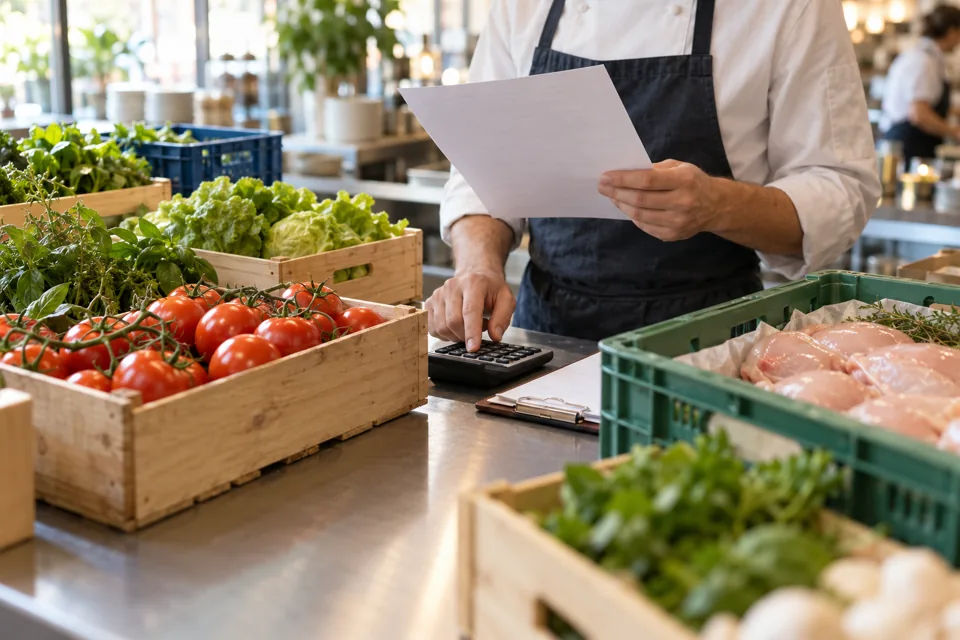
This guide uses a made-up sliced-cheese case to connect supplier price changes, recipe costs and menu margins. It isolates one change so the reason for each updated number stays visible.
Fictional examples. Real decisions need your own data.
Every recipe, price, quantity, date and business situation here is made up for learning. The calculators use stated assumptions and do not forecast demand. Nothing is saved to your workspace or sent to a register.
Compare like with like
The old fictional invoice, dated September 15, 2026, lists $14.00 for 40 usable slices: $0.35 each. The new fictional invoice, dated September 22, lists $18.00 for 40 slices. Assume the same cheese, slice size and usable quality.
A cheaper case may contain fewer usable units. Count the actual unit the recipe needs before comparing prices. If slice weight or yield changes, the comparison needs another explicit assumption.
From example to decision
Explore the scenario in the free demo or get started with your own business documents.
Change the case. Read the recipe impact below.
New unit cost: $0.45 per slice; original unit cost: $0.35. The three menu prices and all other ingredient costs stay fixed.
Breakfast sandwich
1 slice · menu price $8.50
Change in margin per sale
−$0.10New ingredient cost
$2.25Left after ingredients
$6.25What is included?
Other ingredients: $1.80 per plate. Original total $2.15; original remainder $6.35. All figures are fictional. This remainder excludes labor and overhead.
Grilled cheese
2 slices · menu price $9.50
Change in margin per sale
−$0.20New ingredient cost
$2.10Left after ingredients
$7.40What is included?
Other ingredients: $1.20 per plate. Original total $1.90; original remainder $7.60. All figures are fictional. This remainder excludes labor and overhead.
Chicken club
2 slices · menu price $13.00
Change in margin per sale
−$0.20New ingredient cost
$3.90Left after ingredients
$9.10What is included?
Other ingredients: $3.00 per plate. Original total $3.70; original remainder $9.30. All figures are fictional. This remainder excludes labor and overhead.
Click +/− or type. Steps: $0.50 per case / 1 slice. Case count must be a whole number from 1 to 10,000. Values use the same assumed basis excluding sales tax. No recipe or register price is changed.
A replay, not a demand forecast
Assume 100 breakfast sandwiches, 150 grilled cheeses and 80 chicken clubs under both prices. Combined change in ingredient margin: −$56.00.
These are made-up quantities. Keeping volume fixed isolates the ingredient change; it does not estimate next month’s orders or a net profit change.
Do not overwrite the old price to explain old sales
A current invoice answers what a purchase costs now. It does not establish the ingredient cost of a sale from an earlier date. Keep the supplier price, its unit and its effective date attached to the comparison.
The cards assume only one ingredient changes and show three explicitly linked recipes. A real menu review needs the relevant recipe links, serving quantities and other price changes checked. A missing link should be investigated rather than silently treated as no impact.
Before you use this in a decision
Click to work through the assumptions. This checklist stays in this page only.
Follow a price change through Restozia
Start with supported invoices, price lists and recipes. Check the recognized draft, dated prices, units and ingredient matches. In demo step 4, inspect a prepared ingredient change, switch between linked dishes and try a menu price.
The full demo uses its own prepared fictional menu and figures. Your calculator inputs are not transferred. Results remain scenarios, not a forecast.
Questions restaurant operators ask
Open a question to see the explanation.
Why did a cheaper case increase my ingredient cost?
Case price alone is not the unit cost. A smaller pack, fewer usable portions or different yield can raise cost per serving even if the invoice line is lower. Compare the same usable recipe unit.
Does a 20% supplier increase mean a 20% plate cost increase?
Only the affected ingredient portion changes in this example. Its share of the recipe determines the plate-level effect. Other recipe ingredients stay fixed here; real comparisons must check them too.
Can I see the total impact across menu items?
The optional replay multiplies each exact per-sale difference by explicitly fictional counts. It holds the quantities fixed to isolate a cost change. It is not an actual restaurant total or a sales forecast.
Should I immediately raise menu prices?
The calculator does not recommend an automatic price increase. Review the dollars left per sale, the rest of your costs, positioning and demand before deciding. No new price is sent to a register.
Why keep supplier price history?
Effective dates help separate today’s price from a historical calculation. Replacing an old purchase price with the latest one can change the meaning of an earlier comparison. Dates in this example are fictional.
Check the recipe, then check the whole cost picture
Use the plate-cost guide to validate recipe quantities. Use the break-even guide to see why a supplier change is only part of labor, overhead and monthly cost coverage.